More than ever before, the busy pace and time commitments required for success in today’s competitive football world require coaches to stay organized and carefully plan to for unforeseen contingencies that mean the difference between winning and losing each week.
As the entire football coaching staff works to execute their assigned weekly duties to prepare players to execute their individual and collective responsibilities on game-day, it’s the myriad details built inside the game-planning components of daily practice that must pull together to collectively complete the mission needed for in-game success.
Jeff Steinberg, the former head coach at Santiago High School (CA) and author of a Championship Productions’ best-selling football-coaching video, Practice and Game Planning for Friday Night Success, says that careful adherence to the annual plan for your football program, combined with the implementation of weekly practices and daily themes, all work together to reinforce the best attributes of your team.

This combination of planning and preparation provides your team with an edge over opponents through better time management and the overall clarity and confidence that quality preparation brings to players – allowing your athletes to stay poised, task focused and perform reflexively during the chaotic stress of a highly competitive football game.

(Click Here) To Purchase or For More Information on Jeff Steinberg’s Video
Coach Steinberg offers up his best football coaching tips, strategies and proven tactics for an annual calendar for program building and successful game-planning during the season.
Develop a Rock-Solid, Productive Off-Season Plan
Essentially, when you break down the work you need to accomplish to develop your football program into collective components, the plan basically builds itself.
Once the thousand-foot level puzzle is assembled, the coaching staff can begin the task of building and checking off the to-do list of work that comprises each segment of the annual plan.
Leave no stone unturned and it falls on the head coach to ensure that each member of the coaching staff is completing tasks and not allowing smaller, yet critical details to slip through the cracks.
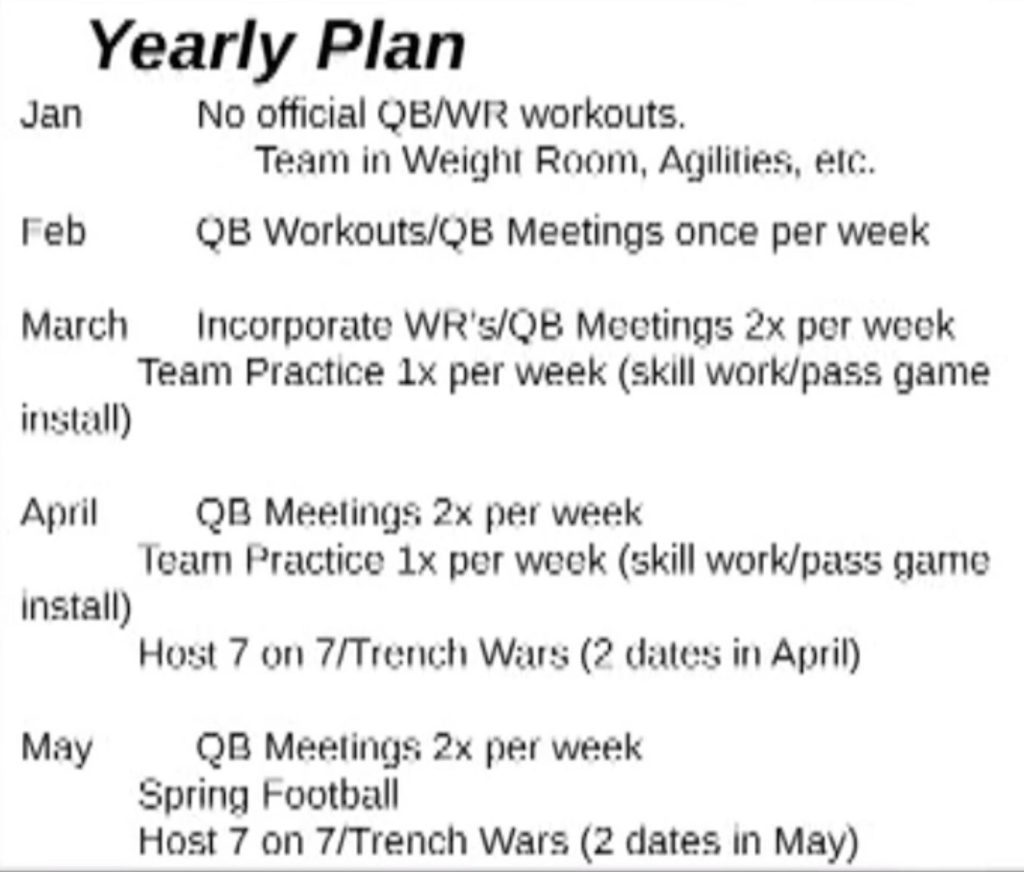
Image A (below) showcases an example of an annual plan for a football program covering the first half of the calendar year. Coach Steinberg provides insight and covers each calendar topic in detail in his coaching video.
The Weight Room – Where True Team Building Begins
The off-season phase of football preparation means developing your players into better athletes through a well-planned focused work in the weight room.
There is nothing more important to your football program than your off-season, pre-season and in-season weight-room work.
Designing an athletic performance program that helps your players maximize their physical potential not only pays dividends on-the-field athletically – allowing athletes to successfully execute their individual in-game assignments during the season – but it also institutes a sense of confidence in the minds of your players, up and down the roster.
Confidence that stems from building and improving a player’s physical attributes in the weight-room is REAL confidence – it’s an EARNED confidence. When a program is comprised of a collective group of confident players who are at their peak, personal bests in physical terms of strength, speed, agility and endurance, it builds your roster’s depth and takes your entire team up to a higher competitive level.
The physical makeup of your roster also dictates the type of offensive and defensive schemes you can utilize. If your players are in superior physical condition over the majority of teams on your schedule, it brings a whole new dimension to a dynamic system such as a no-huddle spread offense.
Make Sure Your Annual Calendar Allows for Multi-Sport Flexibility
If you currently aren’t do so, you should regularly communicate with coaches from other sports within your school to discuss the specifics involved with playing multiple sports. Openly discuss and share the details of your football weight-room workouts with the other sports coaches and learn the type of training they’ll be doing for other sports.
Share the calendar of your annual football program schedule with these other sport coaches as well. Inform them on things like your February QB school, your football spring practice, 7-on-7 leagues you may be participating in, the dates of any position-specific camps (linemen camps, etc.).
Learn about the key calendar dates for other sports and what the daily-weekly practice and game schedule looks like for athletes playing multiple sports. Build flexibility into your annual plan to best accommodates the needs of other sports within your school.
Ultimately, you want the work that players accomplished within your football program to be a positive memory that helps young athletes to learn lessons on achieving their maximum potential through hard work and being a member of a team...
Studies have shown that participation in other competitive sports is good for scholastic athletes, in terms of conditioning, developing a competitive mindset (much more so than individual weight room work) and dynamic muscle training and flexibility that improves aspects of injury prevention.
Once you and the coaches in other sports have looked over the combined multi-sport schedule, be sure you’ve built some open time for your student athletes to improve their mental well-being and cultivate emotional health. Remember, scholastic athletics should be enjoyable and build a sense of pride and community for your athletes.
Even though coaches and players alike continually preach that ‘embracing the grind of daily work’ is a means toward achieving collective goals, this needs to be a positive type of reinforcement that include a sense of accomplishment for short-term and long-term goals. You don’t want your year-round sports work to become miserable, drudgery.
Ultimately, you want the work that players accomplish within your football program to be a positive memory that helps a young athletes to learn lessons on achieving their maximum potential through hard work and being a member of a team.
Your In-Season Daily Plan, Week-To-Week: Evaluate, Refine, Adjust
As you build the framework of your daily schedule for the in-season weeks, start off by looking at Saturdays as the start of your week.
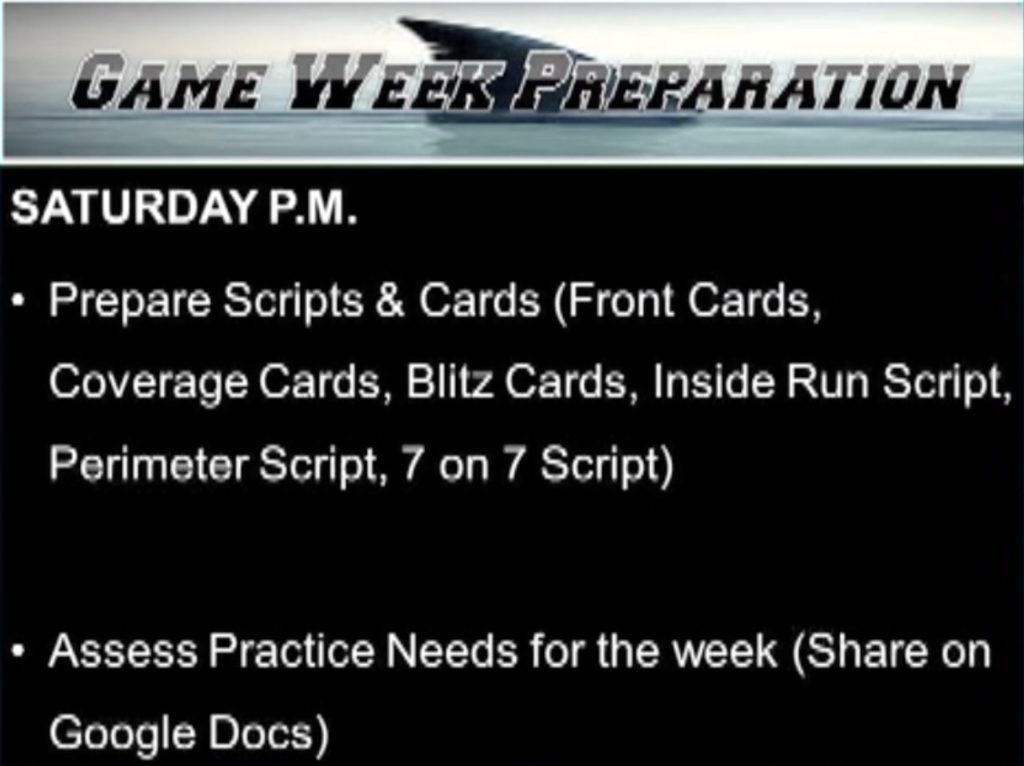
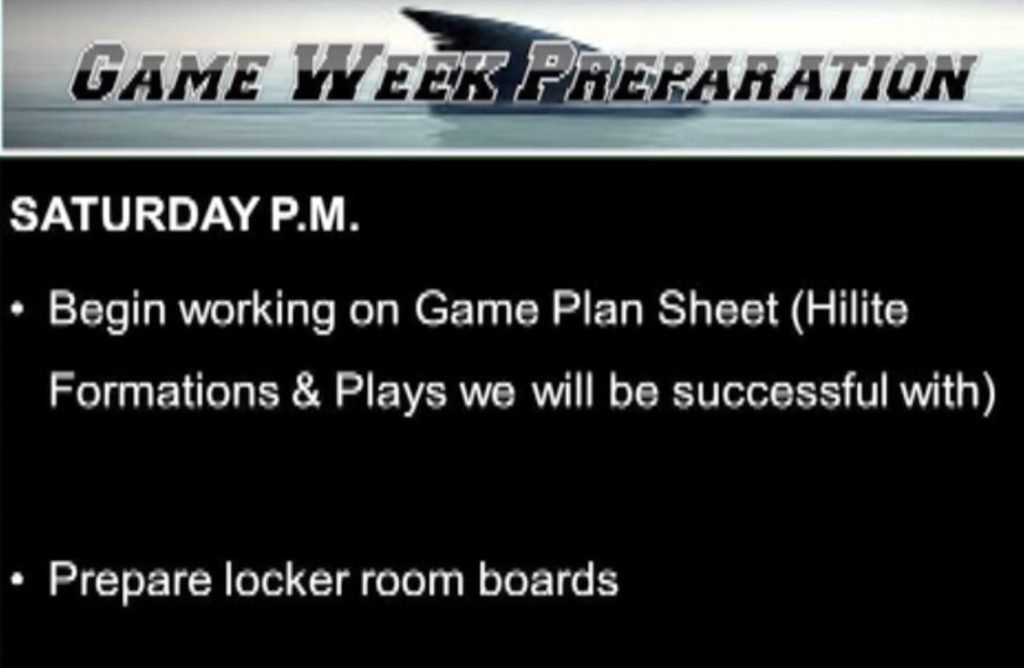
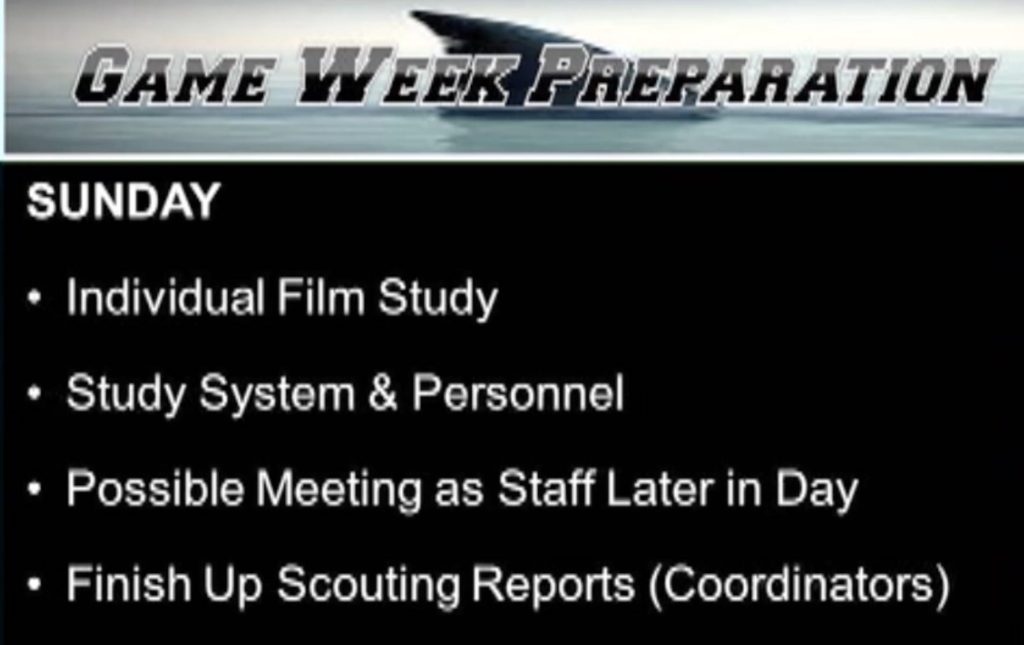
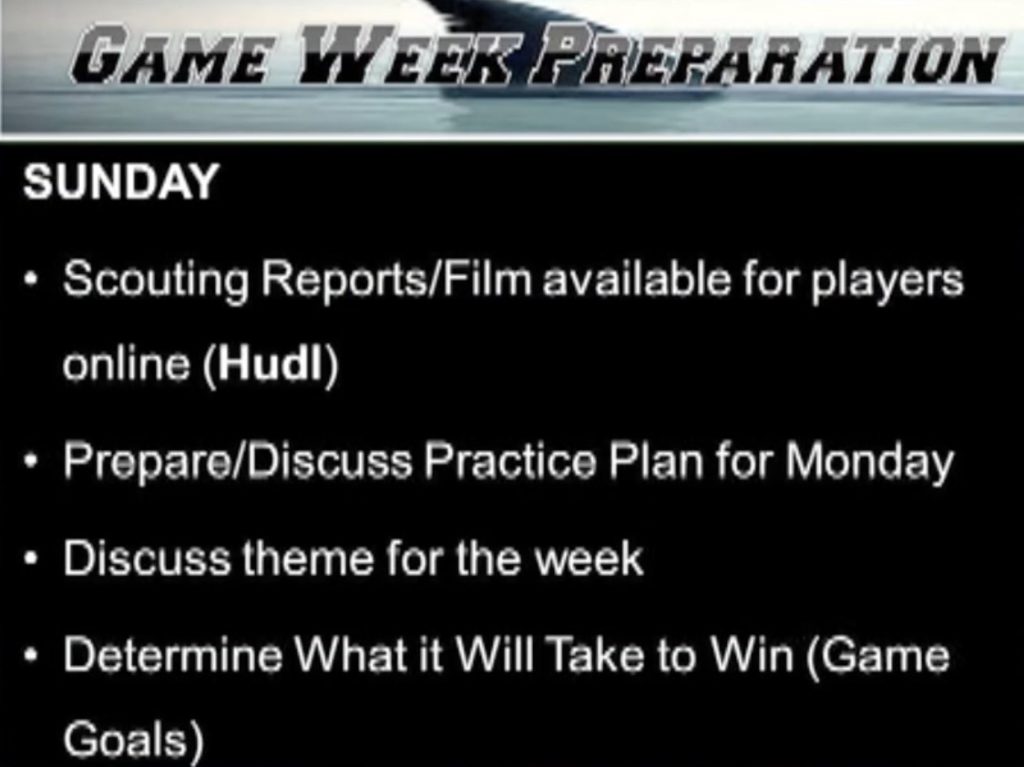
Once you’re off and running during each season, after week 1, Saturdays should become the day where a football coach’s to-do checklist becomes critical. Saturdays are where the process of setting up your work week begins. (See Image B.)
Not only do you evaluate the performance of your players on Saturday film study, but this is where the entire coaching staff works collectively judge how well your overall coaching game plan was put together.
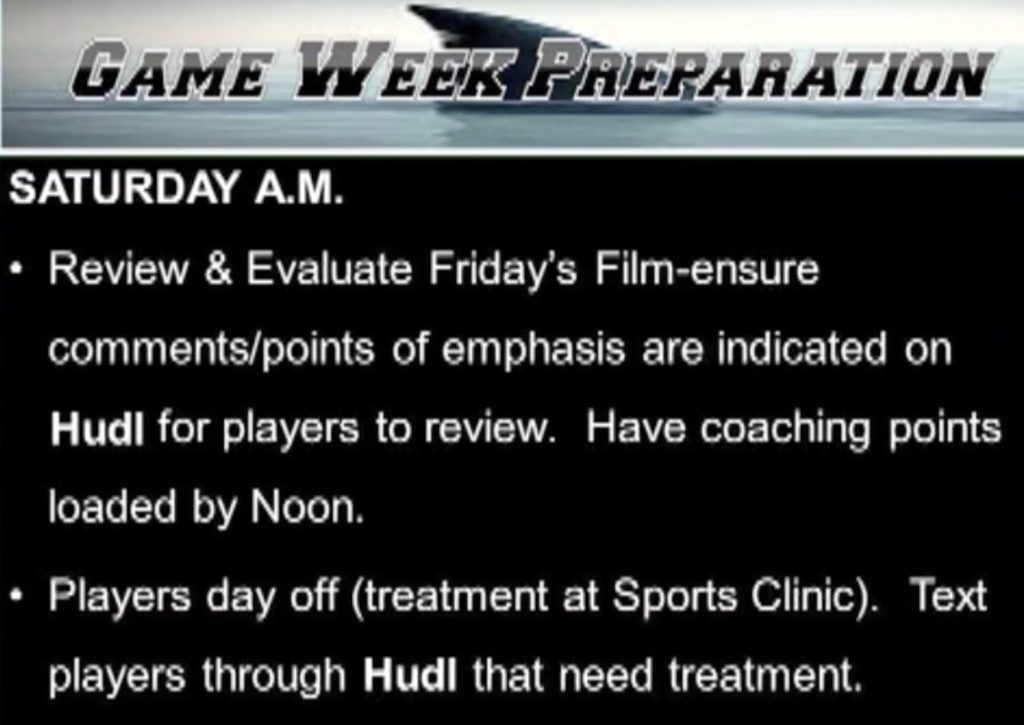
In addition to your to-do work checklist for Saturdays and Sundays, several critical self-analysis questions need to be asked and honestly evaluated as a coaching staff in a variety of key areas. These questions include…
- How well your scouting reports was put together?
- Was the game plan appropriate schematically for the opponent you face?
- What things did you and your staff miss when putting together the game plan? Did the overlooked items impact your team’s ability to execute their assignments?
- What did you do well when creating the game plan?
- How well did the staff prepare players during last week’s practice to execute the game plan you built?
- Did the coaching staff teach the appropriate on-field techniques and emphasis the necessary keys that players needed to properly execute their assignments?
- How well did the coaching staff perform collectively during the game? Where their silly mistakes or errors?
- How was your staff communication from the coach’s box to the sideline? Does the sideline equipment and headsets work? Does equipment need to be repaired / replaced?
- Was the coaching staff on top of in-game situations? In terms of things such as: down-and-distance, time management, use of timeouts, etc.?
- Where your substitution patterns effective and maximized based on personnel, matchups and situation? How were your in-game and half-time adjustments – and where is there room for improvement?
Be brutally honest when asking these questions, and collectively take immediate action to make corrections and implement changes to address coaching staff shortcomings.
Note: The staff evaluation period isn’t meant to become a time for staff finger-pointing and/or throwing one another under the bus. It’s merely an honest assessment period immediately following a game and should be viewed as an opportunity to take action collectively as a staff to change and improve your team’s coaching performance.
The head coach must ensure that this is done as ‘staff strengthening exercise’ done to improve your in-game coaching performance. It’s not the time to finger-point or shirk blame and responsibility onto others. These must be viewed as the things you can change to improve your coaching.
In-Season, Coaching To-Do List: Saturday and Sunday
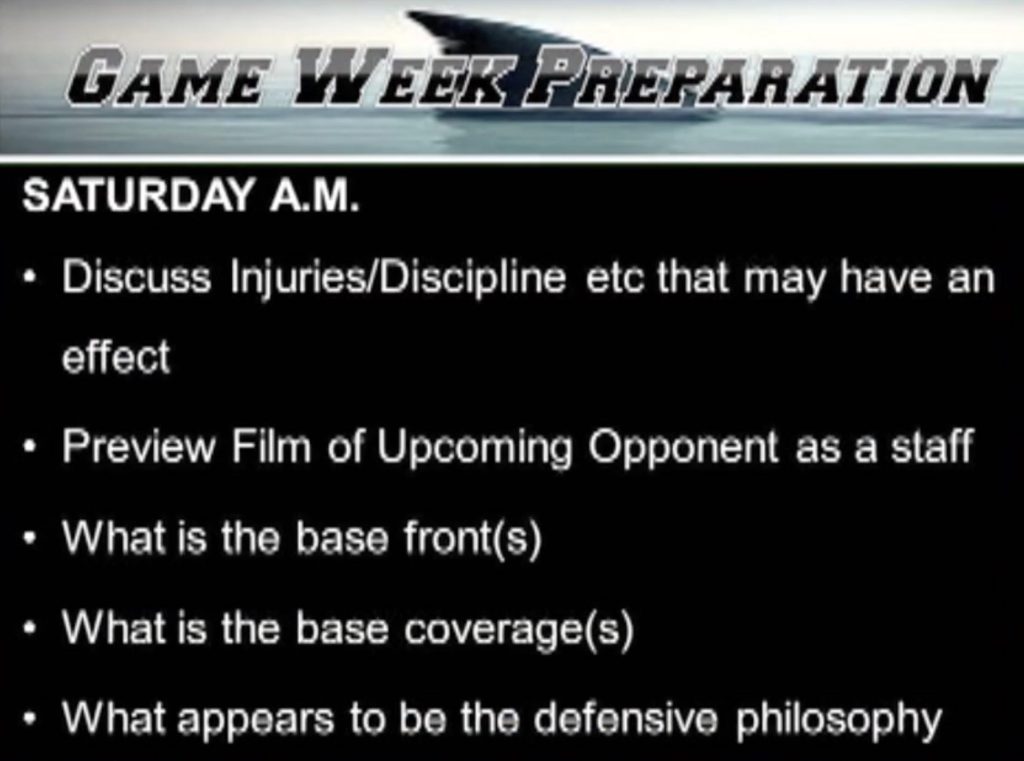
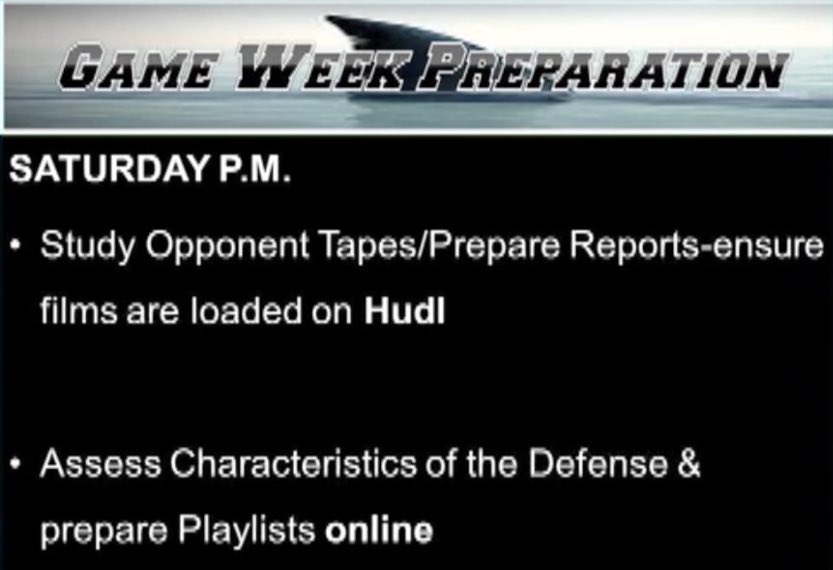
The images below, offer a day-by-day look at a typical in-season duties to be done on Saturdays and Sundays. These are the weekend items that Coach Steinberg says needs to be accomplished without fail.
In Coach Steinberg’s aforementioned video, Practice and Game Planning for Friday Night Success, he offers a deep-dive look at the details surrounding each item on a daily checklist and offers insights into making adjustments to the plan as needed.
The best-selling video also offers a complete analysis with to-do coaching checklist for in-season work on Monday, thru game-day Friday.
(Click Here) To Purchase or For More Information on Jeff Steinberg’s Video