Fifty-three years ago, then-President Richard Nixon authored Proclamation 4157 that declared October 6th be forever deemed, National Coaches Day.
An in-depth look at the proclamation offers tremendous insight on the mission statement of what a coach does and why coaches do what they do.
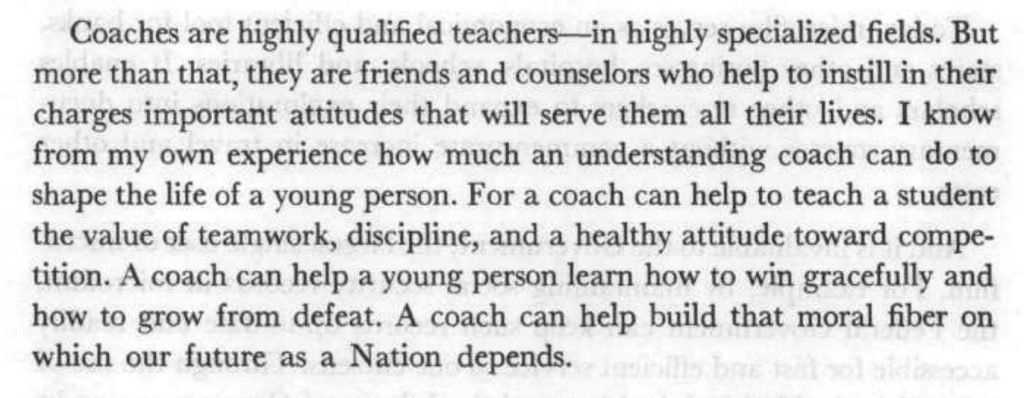
Coming off the 1972 Olympic Games in Munich, it’s interesting to understand the perspective of President Nixon’s and the United States’ view on the importance of sports. Those Olympic Games in particular stand out for two larger-than-life events that most people think about when the phrase ‘Munich Olympics’ is uttered – one tragic and the other controversial.
The proclamation, published on September 19, 1972, came just two weeks after eight terrorists, broke into the Olympic Village and killed two members of the Israeli team, nine hostages and a policeman.
The Olympic Games were suspended for 34 hours, and in defiance of the terrorists, the Games continued at the insistence of the IOC President Avery Brundage, who famously said, “The Games must go on!”

The less tragic, but uniquely controversial Olympic event that also occurred during the 1972 Olympic Games, was the finish of the Gold Medal basketball game between the Doug Collins’ led United States team and the Soviet Union squad, where time was inexplicably added to the clock after game was over, leaving the USSR squad with one additional, final full-court inbounds play and down by a point, 50-49. (See the video below to watch the Soviet team win the Gold Medal.)
So it was through the lens of those memorial Olympic sports moments in 1972 that this proclamation was drafted. Even still, Proclamation 4157 showed a great understanding of the place of sports in society and the benefits that athletes at all levels of competition reap from their coaches.
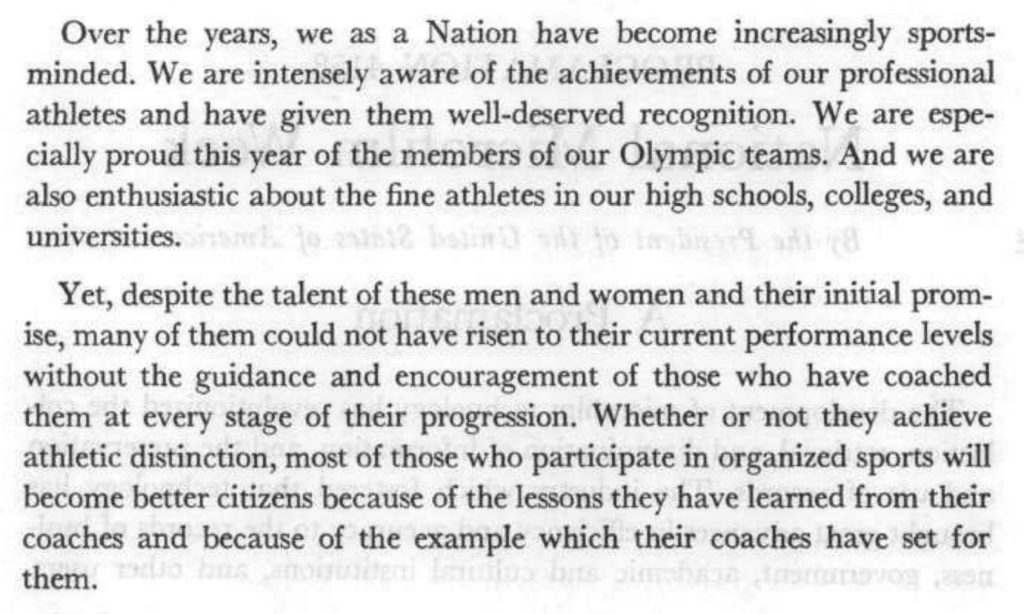
President Nixon’s proclamation even showed an understanding for the under-appreciated nature of the continuous work that sports coaches put into their chosen field.
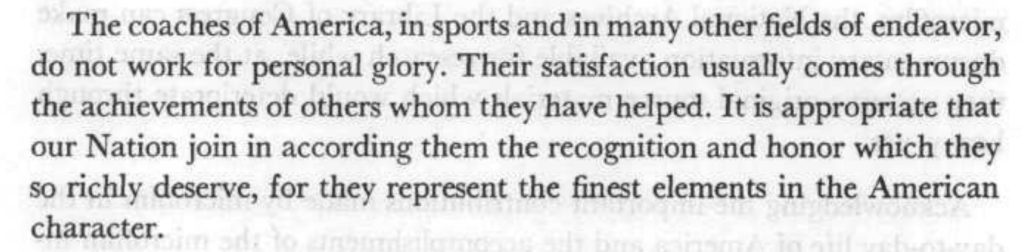
No one in 1972, however, could have ever envisioned all the additional things that coaches of today’s modern sports world manage – things that go above and beyond the spectrum of a coach providing guidance and wisdom derived from a coach-athlete mentoring type of relationship.
Whether it’s dealing with overbearing parents, the tasks of non-stop, year-round fundraising for their athletic program, trying to manage athletes on social media, dealing with more hands-on athletic administration policies, dealing with other coaching ‘voices’ – such as travel club vs scholastic sports coaches or competing sports programs trying to get athletes to transfer – the layers of the ‘modern-sports onion’ run a lot deeper today, and they are substantially more complex than they were 50-some years ago.
Still, that’s exactly what makes National Coaches Day such an important day of the year. It’s a recognition of your role as a coach and sheds the spotlight on all those extra things that are often overlooked by those in the non-coaching world.
It is not a stretch to say that in any given 8 to 12 week high school season, the coach may spend more time with their athletes in those 8 to 12 weeks – more than any other person in their life – given the 60 to 90 minutes of practice time each day + weekly game/travel/competition time; and in that stretch; in short, the coach might possibly be the most influential adult in their lives.
Coaches play a critical role in society and the work the do to imbue their guidance on young athletes – to help them become high-quality, servant-leaders of society as they grow to be adults is so important.
This vital responsibility often does not come with extra pay or even additional accolades beyond winning championships – which few coaches get to achieve in most sports seasons, if ever.
Today is a celebration of YOU – and all the extra efforts YOU put into your role as a coach of athletics.
On behalf of everyone who does not notice or appreciate these efforts the other 364 days of the year, on National Coaches Day, October 6, we say, ‘Thank You!’